Dental marketing automation should handle routine follow-up while your team keeps clinical judgment, patient-specific advice, consent decisions, and sensitive conversations. For cosmetic dental practices, the right boundary is simple: automate repeatable communication, not decisions that require a clinician or an accountable staff member. An illustrative smile preview supports a conversation; it is not a treatment plan or a guaranteed result.
- Dental marketing automation handles routine patient follow-up; your team owns clinical judgment and sensitive conversations.
- Smileo combines AI smile previews, patient nurture, and virtual consultations for cosmetic dental practices evaluating an all-in-one app.
- Keep smile previews separate from treatment recommendations, consent discussions, and promises about results.
- Test staff handoffs in a demo, not just the patient-facing experience.
Dental marketing automation: what should stay with your team?
Keep any decision that changes patient expectations, clinical advice, or consent with your team. Automation can support the conversation. It should not become the final authority on what treatment a patient needs or what outcome they should expect.
Smileo is built for cosmetic dental practices seeking smile previews, patient nurture, and virtual consultations in one app. Start with the capabilities described on the Smileo website, then use a demo to examine the boundary between automated communication and staff responsibility.
Use this ownership split when reviewing dental marketing automation in 2026:
| Responsibility | Appropriate automation role | What stays with your team |
|---|---|---|
| Routine follow-up | Support repeatable, practice-approved communication | Approve messages and decide when personal contact is needed |
| Smile previews | Present an illustrative visualization | Explain limitations and assess clinical suitability |
| Virtual consultations | Support the consultation workflow | Interpret patient needs and provide appropriate professional advice |
| Patient concerns | Support a route to staff attention | Address distress, complaints, confusion, and individual circumstances |
| Consent decisions | Support communication around practice-approved processes | Explain what patients are agreeing to and answer questions |
| Workflow oversight | Support the process your practice selects | Assign ownership, review problems, and correct mistakes |
The benefit of automation is consistency in repeatable work. The limitation is context: a message that fits one inquiry can be inappropriate for another. Your team needs authority to interrupt the process, change the conversation, and take responsibility for the next step.
Why this matters
Cosmetic dental inquiries involve more than appointment interest. A prospective patient can be curious about appearance, uncertain about treatment, or concerned about sharing a photograph. Those are different conversations, even when they begin through the same form.
A buying decision based only on message volume misses that distinction. In your 2026 evaluation, ask whether the software supports your practice's responsibilities—not whether it can replace every staff interaction.
The goal is a clear division of work, not the highest possible level of automation. A repeatable administrative task and a patient-specific clinical question should not follow the same decision process.
Clinical judgment stays with the clinician
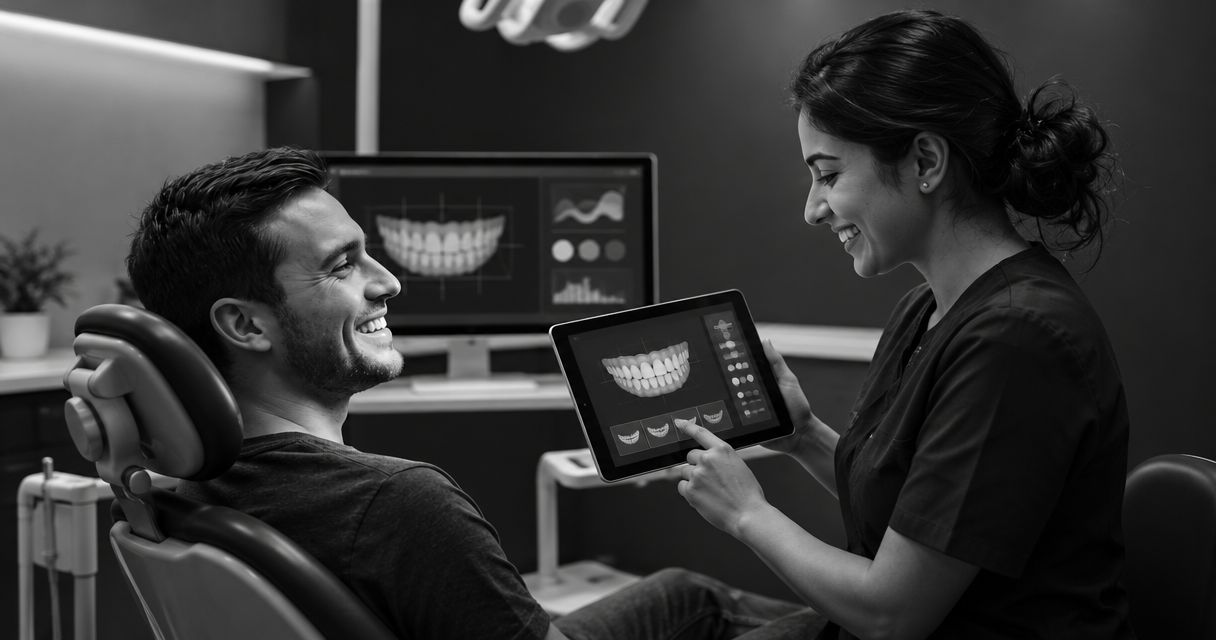
A smile preview can help a patient express a preference. It cannot establish whether a particular treatment is suitable, what clinical work is required, or whether a pictured appearance is achievable.
Your clinicians retain responsibility for assessment and recommendations. Practice staff should understand that boundary, too. An enthusiastic response to a preview is not a substitute for clinical evaluation.
What should your team say about a smile preview?
Describe the image as illustrative. Explain that treatment recommendations and expected outcomes require professional assessment, rather than letting the image speak for itself.
Hypothetical example: A prospective patient likes a preview and asks whether veneers will produce that exact appearance. Your team should acknowledge the preference and direct the treatment question to a clinician. An automated reply should not confirm suitability or promise the pictured result.
In a demo, ask how your practice can present limitations and move clinical questions to a qualified person. Evaluate the explanation patients receive, not just the visual appeal of the preview.
Patient concerns stay with a person
Routine follow-up and a sensitive conversation have different purposes. Routine follow-up helps maintain contact. A sensitive conversation requires listening, clarification, and a response suited to the person.
Keep complaints, distress, dissatisfaction, and confusion under staff ownership. Clinical symptoms belong with the appropriate clinical team, not inside a promotional conversation.
Ask the vendor to demonstrate the staff handoff. Do not assume the presence of messaging means your team has the controls or visibility it needs.
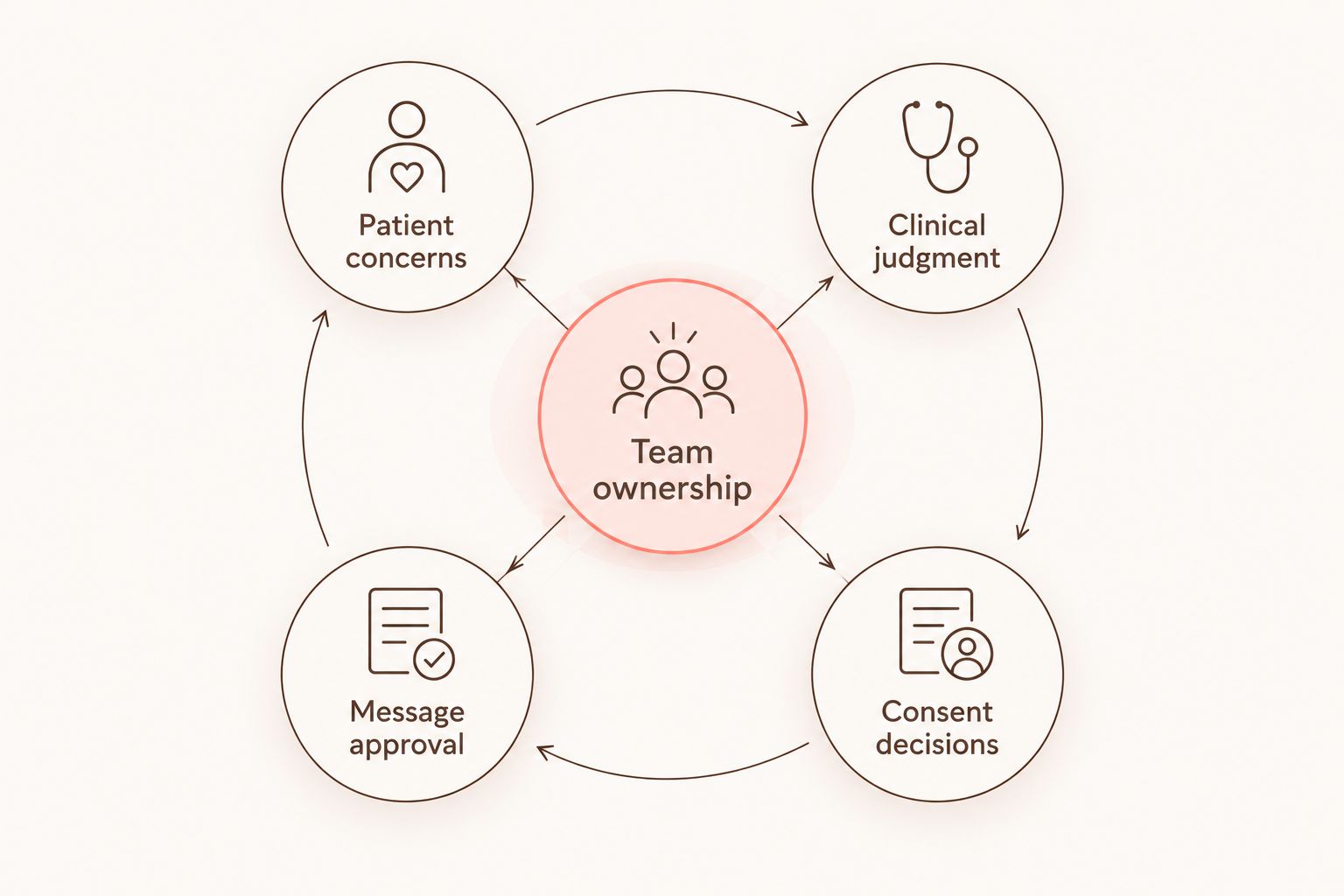
- Patient concerns: Who receives a concern, and who owns the response?
- Clinical judgment: Who handles questions about suitability or symptoms?
- Message approval: Who can approve or change patient-facing language?
- Consent decisions: Who explains the practice's process and answers questions?
These responsibilities need a named owner within your practice. Shared access does not automatically create accountability.
Message approval stays with your practice
Your practice should decide what its communication says and what it must never imply. That includes how staff describe previews, consultations, treatment expectations, and the next appropriate action.
Review meaning, not just spelling. A polished sentence can still imply a result your clinician has not assessed or make an exploratory inquiry sound like a treatment commitment.
Use a short approval checklist:
- Does the message distinguish an illustrative preview from clinical advice?
- Does it explain the next step without promising an outcome?
- Does it give the patient an appropriate way to ask a question?
- Does it avoid language that pressures someone who remains uncertain?
- Does it match the responsibilities of the person receiving the reply?
For a 2026 software review, ask who can approve changes and how your practice would correct an unsuitable message. Treat those as buying questions. Do not assume a vendor offers a particular control until it is demonstrated.
Consent and privacy decisions stay accountable
Patient photographs, contact details, and consultation information deserve deliberate handling. Your practice needs to understand what information enters a workflow, why it is needed, and who is responsible for its use.
Keep the evaluation practical. Ask the vendor to explain data handling, access, retention, and the documentation available for your privacy and compliance review. Have the appropriate practice adviser assess whether the arrangement meets your obligations.
Do not treat a general security statement as the complete answer. Ask about the actual workflow your team intends to use, including information moving between tools.
The same principle applies to patient consent. Software can support a process, but your practice remains responsible for deciding what requires explanation and who answers questions. A patient agreeing to receive communication is not the same decision as agreeing to treatment.
What changes the right automation boundary?
The right split depends on the task, the information involved, and the judgment required. Use these factors to decide what deserves staff ownership:
- Clinical content: Questions about suitability, symptoms, or expected treatment results require clinical attention.
- Patient expectations: A preview that prompts treatment questions needs a clear explanation of its limits.
- Conversation sensitivity: Complaints, distress, or confusion call for personal attention rather than routine promotion.
- Information involved: Photographs and consultation details require a deliberate privacy review.
- Staff responsibility: A workflow needs someone accountable for unanswered questions and exceptions.
- Existing tools: Connections between systems need confirmation before you rely on them in daily work.
These are evaluation criteria, not reasons to reject automation. They help you place it where the work is repeatable and keep people responsible where the decision is consequential.
How should you test the handoff in a software demo?
Ask the vendor to show an ordinary inquiry and an exception. A smooth demonstration of the happy path does not answer what happens when a patient needs something different.
Use a hypothetical practice scenario rather than real patient information. Keep the exercise focused on buyer decisions and staff responsibilities.
- Start with an exploratory inquiry. Ask how a prospective patient encounters the preview and understands its purpose. Look for a clear distinction between visualization and treatment advice.
- Introduce a treatment question. Ask what happens when the patient wants to know whether a procedure is appropriate. Identify who owns the response.
- Introduce uncertainty. Ask how staff would handle someone who is confused, concerned, or no longer interested in routine follow-up. Have the vendor demonstrate available controls rather than describe an ideal process.
- Review the consultation handoff. Ask what your team needs to review before the consultation and who is responsible for addressing outstanding questions.
- Confirm the operating requirements. Ask about staff access, available connections, privacy documentation, and the work your practice must do to maintain the process.
End by separating demonstrated capabilities from items that require further confirmation. That distinction belongs in your purchasing decision, not in an assumption made after signing.
Where does an all-in-one app fit?
Smileo is best for cosmetic dental practices evaluating smile previews, patient nurture, and virtual consultations together. Its relevance is the combination of those capabilities in one app, not a promise that every practice responsibility disappears.
That scope gives you a focused demo agenda. Review how the app supports each part of the patient conversation and where your staff takes over.
The trade-off is evaluation depth. One app covering several activities still needs careful review of each activity. A convincing preview demonstration does not settle your questions about follow-up, consultation responsibilities, or privacy.
For your 2026 shortlist, describe integrations as a connection to confirm, not a capability to assume. Ask about flexible ways to connect your existing tools without treating universal compatibility as a given.
Review the current pricing page for public commercial information. Then book a Smileo demo to test your practice's responsibilities against the actual workflow. Keep that conversation focused on fit, staff ownership, and confirmed capabilities—not predicted booking or revenue outcomes.
Can dental marketing automation replace your treatment coordinator?
Dental marketing automation should support your treatment coordinator, not replace patient-specific judgment. Keep questions about expectations, uncertainty, and the appropriate next step with an accountable person.
Before changing staffing responsibilities, identify the work that remains. Someone still needs to review exceptions, answer questions, and coordinate with the clinical team.
Should automated follow-up continue after a patient raises a concern?
A patient concern needs staff review before your practice treats the conversation as routine follow-up. The appropriate next step depends on what the patient has said and who is qualified to respond.
During evaluation, ask the vendor to demonstrate how staff can manage that situation. Do not infer the answer from a standard follow-up example.
FAQ
What should dental marketing automation never decide on its own?
Dental marketing automation should not independently decide clinical suitability, treatment recommendations, or promised results. Your team should also retain responsibility for consent discussions and sensitive patient concerns.
Is an AI smile preview the same as a treatment plan?
An AI smile preview is an illustrative visualization, not a clinical treatment plan. A clinician must assess suitability and explain treatment options and expected outcomes.
What's the best way to evaluate dental marketing automation in 2026?
Evaluate dental marketing automation in 2026 by testing both routine communication and a patient concern that needs staff attention. Ask the vendor to demonstrate the handoff and identify what your practice must manage.
Can automated follow-up handle every patient question?
Automated follow-up should not handle every patient question independently. Clinical questions, complaints, distress, and confusion need an appropriate person to review and respond.
What should I ask about connecting software to our existing tools?
Ask which connections are confirmed for your existing tools and what setup your practice would need. Do not assume that flexible integration options mean universal compatibility.
Is Smileo intended for patients or dental practice owners?
Smileo is an app built for cosmetic dentistry practices, combining AI smile previews, patient nurture, and virtual consultations. Practice owners should evaluate how those capabilities fit their team's responsibilities.
One last thing
Evaluate the moment automation should stop, not just the moment it starts. Before approving a workflow, name the person responsible when a patient asks something the standard communication cannot appropriately answer.
That is a practical final check for your 2026 buying decision. If staff ownership remains unclear, resolve it before making the workflow part of daily practice.